1. Why UGC pricing isn't influencer pricing
The most common budgeting mistake brands make with user-generated content is pricing it the same way they'd price an influencer post — by follower count. It doesn't work, because the two are fundamentally different jobs. An influencer is paid, in large part, for their audience: their price scales with reach because the brand is renting access to people who already follow them. A UGC creator is hired for something else entirely — the skill of making content that looks native, authentic and scroll-stopping, which the brand then posts, runs as a paid ad, or hands to its in-house social team. The creator's own following barely factors in, because in a pure UGC deal, the content rarely if ever touches their own profile.
That distinction shows up constantly in practice. A UGC creator with a few hundred followers and a genuinely good eye for pacing, lighting and hook-writing can produce an ad that outperforms content from a creator with 50,000 followers who has never shot anything designed to survive the first three seconds of a scroll. Sprout Social's research on UGC backs this up from the demand side: the reason brands are pouring budget into UGC in the first place is that audiences trust it more than polished brand content or even influencer endorsements, precisely because it doesn't look like an ad.
Because of that, this guide — and the free UGC Creator Rate Calculator that goes with it — price UGC the way the market actually prices it: by creator experience and portfolio strength, deliverable type, niche, and the factor almost every brand underestimates on their first UGC campaign: usage rights.
It's also worth being precise about why brands are willing to pay for this in the first place. Sprout Social's 2026 research found that 66% of consumers talk to friends and family to keep up with trends, and that consumers rank authenticity and relatability as the top two traits they want from brand content — which is exactly what a well-made UGC video supplies and a studio-lit brand ad usually doesn't. The same research ties this directly to revenue: 81% of consumers say social media drives purchases they make multiple times a year. None of that is a reason to overpay for UGC, but it is the reason the category exists and keeps growing, and it's worth remembering when a creator's quote feels high relative to their follower count — you're not paying for their audience, you're paying for content built to do a job an in-house team or a stiff ad usually can't.
2. 2026 base rates by experience level
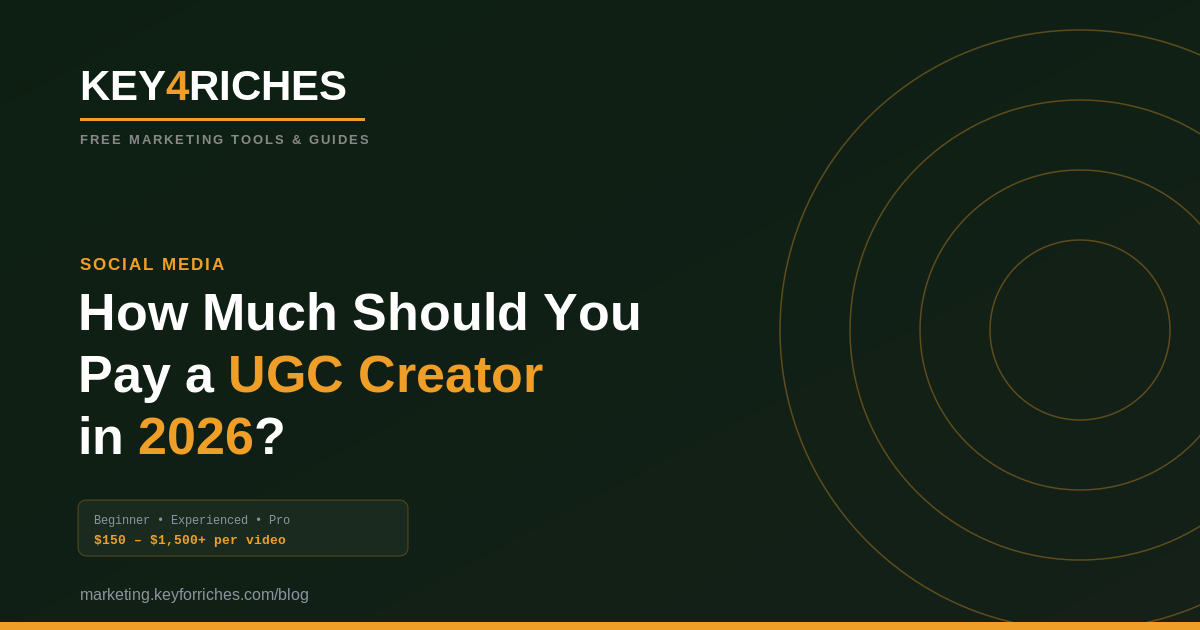
2026 rate research from Influee and JoinBrands groups UGC creators into three practical experience tiers, each with its own typical range for a single edited video deliverable, licensed for organic use:
Beginner (0–1 year): $150–$300 per video. Creators at this stage are usually still building a portfolio and case studies, and will sometimes shade toward the low end of that range in exchange for usable footage they can show future clients.
Experienced (1–3 years): $400–$800 per video. This is where most brands end up for dependable, repeatable content — a real portfolio, a track record of on-time delivery, and enough past client work that the hire is fairly low-risk.
Pro (3+ years, proven results): $800–$1,500+ per video, sometimes considerably more for creators who can point to measurable ad performance rather than just attractive footage — click-through rate, watch time, or conversion lift on past sponsored content.
Zooming out, broader market research puts the full observed range for UGC video at roughly $75 to $500+, with $200–$300 cited as the going rate for a creator with a solid portfolio and demonstrated results — landing almost exactly at the low end of the "Experienced" tier above. These three tiers are the same base ranges used in the calculator before any adjustment for deliverable type, niche, usage rights or order volume.
3. Deliverable type: the second-biggest price lever
Within the same experience tier, what you're actually asking a creator to produce changes the price almost as much as their skill level does. A photo set (three to five images) typically runs at around 60% of a single edited video's rate — there's no pacing, voiceover, or hook-writing involved, and turnaround is faster. A long-form or demo video, running 60–90 seconds or more and walking through a product in real depth, commonly runs 30–40% above a standard 15–60 second UGC video, since it demands more filming time, more takes, and often a written script. Raw, unedited footage — where the brand's own team handles editing — typically comes in below a fully edited deliverable, because editing time is one of the single biggest cost drivers in UGC pricing, right alongside usage rights.
The practical lesson carries over from influencer briefing: a vague ask gets a vague, padded quote. "A UGC video" invites a creator to price in a buffer for the unknown. "One 30-second vertical video, front-facing to camera, product shown in the first 5 seconds, one round of revisions included" gets a tighter number, because the creator isn't guessing at your scope.
4. Usage rights and whitelisting: the real cost driver
This is the single biggest way UGC pricing surprises brands who are used to buying influencer posts. A creator's base rate typically covers content licensed for the brand's own organic channels — your Instagram, your TikTok, your website. The moment you want to run that same clip as a paid ad, you're licensing something different, and 2026 industry data is consistent on what that costs: usage rights extending beyond about 30 days typically carry a 20–30% premium over the base content fee, and a full year of paid-ad usage commonly runs 50–100% above the base creation fee — in other words, licensing the ad usage can cost as much as, or more than, making the content in the first place.
Whitelisting — where the brand gets direct ad-account access to run paid spend through the creator's own handle, sometimes called Spark Ads or Partnership Ads depending on the platform — sits a tier above that again, commonly adding a further 50–100% on top of the base video rate according to the same research. Stack category exclusivity on top, which the same data prices at another 25–50% premium, and a single premium-niche video with full whitelisting and exclusivity can legitimately run several times the base creation fee. Brands who budget only the "content" line item are routinely blindsided by the real invoice once usage rights are added — which is exactly the gap this calculator is built to close before you're mid-negotiation.
The fix is the same one that works for influencer deals: decide upfront exactly what usage you need — organic only, a defined paid-ad window, or full whitelisting — and put it in the very first brief. Asking for expanded rights after content is already delivered and performing well as an ad is where nearly every UGC pricing dispute starts.
5. How niche shifts the baseline
Because UGC pricing doesn't run on audience size, niche premiums come from a different place than they do in influencer marketing: how valuable the brand's customer is, not how large the creator's following is. 2026 UGC research reports that specialized categories — B2B SaaS, FinTech, and health or wellness tech — command rates roughly 50–100% above general lifestyle content. Part of that is scarcity: far fewer creators can speak credibly about a compliance dashboard than can review a skincare product on camera. Part of it is simple economics — brands selling a $500/month SaaS tool or a regulated financial product typically have a much higher customer lifetime value to justify paying a premium for content that has to land with a more skeptical, higher-stakes audience.
General lifestyle, beauty, food and home content stays closer to the base rate largely because supply is abundant: there's no shortage of creators comfortable filming a "get ready with me" or a recipe video, which keeps that end of the market competitive.
6. Volume discounts and bundle pricing
Ordering more than one deliverable from the same creator is routine, and bundle pricing is standard industry practice rather than a special favor you need to negotiate for. Reported TikTok volume pricing shows roughly a 17% discount on a 3-video bundle compared to paying for three individual videos at full price, and the discount typically widens further at higher volumes, since the creator saves on discovery, briefing and onboarding time per additional piece. If you already know you'll need an ongoing supply of content — say, a monthly batch of UGC ads for testing — negotiate the bundle or retainer rate from the outset rather than re-negotiating from scratch every time.
7. Disclosure: the compliance cost that isn't optional
One cost in a UGC deal isn't a pricing lever at all — it's a legal requirement. Any UGC content with a "material connection" to the brand — payment, free product, or any other benefit that could reasonably affect how an audience weighs the content — requires a clear disclosure under FTC guidance. This applies whether the content stays on the creator's own profile, gets reposted by the brand, or runs as a whitelisted ad through the creator's handle: wherever it's published, the sponsorship has to be obvious to an ordinary viewer, in plain language like "ad" or "paid partnership," not buried in a caption or a vague tag like "collab."
This isn't optional and it isn't priced into the calculator above, because it's not negotiable — it's a compliance requirement both the brand and the creator can be held responsible for if it's missing. Build it into every brief and every piece of content from the start; it's far cheaper to get right the first time than to fix after the fact.
8. How to actually negotiate the number
Run the calculator with your best information first, then treat the result as your opening anchor rather than a final offer. If you're the brand, it's reasonable to open near the low end of the range that matches the usage rights you've actually specified — and to be transparent from the first message about whether you'll want paid usage or whitelisting down the line, since retroactively asking for it is where most disputes begin. If you're the creator, the high end of the range plus real performance data — watch time, click-through rate, conversion lift on past sponsored content — justifies pricing above the generic benchmark far more effectively than the benchmark number itself.
Either way, remember that no benchmark tool can see the variable that matters most in UGC: whether a specific creator's tone, pacing and delivery style actually fit your brand and your audience. A strong portfolio match is worth more in practice than any multiplier in this guide.
9. Common UGC pricing mistakes on both sides
Brands most often go wrong by budgeting only the content-creation fee and getting blindsided later by usage-rights or whitelisting costs, by sending a vague brief and expecting a precise quote back, or by trying to add paid usage after content is already live and performing well. Creators most often go wrong by pricing purely off a flat "per video" number without factoring in what usage rights are actually being requested, or by not having usage-rights and whitelisting pricing ready when a brand asks — hesitation here reads as inexperience and invites lowball offers. The fix on both sides is the same one that works everywhere in marketing: come to the conversation with real numbers, a specific brief, and every deal term — deliverables, usage window, whitelisting, exclusivity — spelled out before either side signs.
Get a real rate estimate in seconds
Enter a creator's experience level, deliverable type, niche and usage rights to get a benchmark-based price range — instantly, free, no signup.
If you're weighing UGC against a traditional sponsored post, see how much to pay an influencer in 2026 for the follower-driven side of creator pricing. If the UGC you're commissioning is a short-form video specifically, short-form video scripts that don't get skipped covers the hook and pacing structure worth briefing your creator on, and CPC, CPM and ROAS explained helps you judge whether the paid usage you licensed is actually earning back its premium.