1. Why Readability Quietly Affects Your Rankings
Readability isn't one of the ranking signals Google names directly, and no reputable source will tell you a Flesch score alone moves you from position 8 to position 3. What it does affect is everything Google's ranking systems actually measure as proxies for quality: how long people stay on the page, whether they scroll to the end, whether they pogo-stick back to the results, and whether an algorithm can cleanly extract a self-contained answer for a featured snippet or AI Overview. Google's own guidance on creating helpful, reliable, people-first content asks whether a page "provides a satisfying experience" and whether visitors would "feel they've had a good experience" — both of which are much harder to achieve when a reader has to reread a sentence twice to parse it.
There's also a compounding effect with E-E-A-T. Dense, over-qualified, jargon-heavy writing often correlates with weak expertise signals in practice, not because complexity is inherently bad, but because writers who genuinely understand a topic can usually explain it more simply than writers padding out thin research. Clear writing is frequently a symptom of clear thinking, and unclear writing is often a symptom of the opposite — which is part of why quality raters and algorithms alike tend to reward it, even indirectly.
2. How People Actually Read Web Content
The case for readability gets stronger once you know how people actually engage with a page. In one of the most cited pieces of UX research on the subject, the Nielsen Norman Group's original eyetracking study — later revisited and confirmed — found that users scan web content in an F-shaped pattern: a horizontal sweep across the top, a shorter horizontal sweep further down, then a vertical scan down the left side looking for anything worth stopping for. Readers do this because they're being efficient, not lazy — when a page is a wall of undifferentiated text, scanning it in an F-shape is often the fastest way to decide whether it's worth reading in full.
That single finding explains most of what "readable" content actually looks like in practice: short paragraphs, sentences that don't require holding four clauses in working memory at once, and structure (headings, bold key terms, lists where they genuinely help) that gives a scanning eye somewhere useful to land. It also explains why the readability formulas below — built for sentence-level clarity — only tell half the story; page-level structure matters just as much as sentence-level simplicity.
3. The Five Scores That Measure Readability
Modern readability checkers, including our own free Content Readability Checker, report several distinct formulas rather than one score, because each one weighs sentence and word complexity slightly differently and they're most useful together. All five predate the SEO industry by decades — Flesch Reading Ease was published by Rudolf Flesch in 1948, Gunning Fog followed in 1952, SMOG in 1969, and Flesch-Kincaid Grade Level and Coleman-Liau both arrived in 1975, according to the formula histories collected by Readable's readability-formula reference. They were built for classrooms and technical manuals, not blog posts, but they remain the closest thing writers have to an objective, repeatable readability check.
Flesch Reading Ease scores 0-100, higher is easier, based on average sentence length and average syllables per word. Flesch-Kincaid Grade Level converts similar inputs into a US school grade — an 8 means an eighth grader should follow it on one pass. Gunning Fog also estimates a grade level but weighs "complex words" (three or more syllables) more heavily, so it tends to run higher on technical writing full of legitimate jargon. SMOG is similar but was designed specifically for shorter passages, and it's most statistically reliable at 30+ sentences. Coleman-Liau is the odd one out: instead of counting syllables (which automated tools can miscount on unusual words), it uses letters-per-word and sentences-per-hundred-words, which makes it a useful second opinion when the syllable-based scores disagree.
4. What "Good" Looks Like: Practical Targets
The most widely used benchmark in SEO content tools comes from Yoast, whose plugin has historically marked a Flesch Reading Ease score of 60-70 as "good" — roughly the level of a typical newspaper article, understandable by 13-15 year olds. That target isn't arbitrary. Research from the OECD's Programme for the International Assessment of Adult Competencies, tracked in the US by the National Center for Education Statistics, puts the average American adult's reading proficiency at roughly a 7th- to 8th-grade level. Writing meaningfully above that level — even for a well-educated audience — narrows who can comfortably read your content without extra effort, and "extra effort" is exactly what the F-shaped scanning pattern from the last section tells us readers try to avoid.
In practice: aim for Flesch Reading Ease 60+ and a Flesch-Kincaid grade of 7-9 for general blog posts, landing pages, and help documentation. Grade 9-12 is reasonable for genuinely technical, developer-facing, or B2B content — forcing inherently technical material down to a sixth-grade score usually means stripping out precision your audience actually needs, not improving clarity. There's no universal "correct" score; the target is the level your specific audience can read without friction, checked against the general population benchmark above as a floor, not a ceiling.
5. Five Habits That Wreck Readability
Long, compound sentences. Every additional clause forces working memory to hold more open threads before resolving the sentence. A 40-word sentence with three subordinate clauses is disproportionately harder than two 20-word sentences saying the same thing — this is exactly why the Content Readability Checker flags every sentence over 25 words individually rather than only reporting an average.
Passive voice, overused. "Mistakes were made during the deployment" hides who did what; "The deploy script skipped a config check" says it directly and, incidentally, uses fewer words. Passive voice isn't always wrong — it's the right choice when the actor genuinely doesn't matter — but articles that lean on it throughout read as evasive and take longer to parse.
Unnecessary jargon and throat-clearing. Phrases like "it is important to note that," "in order to," and "leverage" instead of "use" add syllables without adding meaning. Cutting them is close to a free win: it shortens sentences and raises every readability score simultaneously.
Nested qualifiers. Sentences that pile on caveats mid-clause ("the tool, which in most but not all cases and depending on configuration, will typically return...") force a reader to hold the caveat, the exception, and the original claim in memory at once. Move qualifiers to their own sentence instead.
Walls of text. This one is structural rather than sentence-level, but it compounds everything above. A technically readable paragraph that runs twelve lines with no break still triggers the F-shaped scan-and-abandon pattern. Break at natural idea boundaries, not at an arbitrary line count.
6. Readability vs. Keyword Density
Readability and keyword optimization can pull in opposite directions if you're not careful — repeating an exact-match keyword phrase to "hit a density target" almost always makes a sentence more awkward, not less. Most practitioners treat roughly 0.5-2.5% keyword density (occurrences of your target phrase relative to total word count) as a reasonable range; well above 3% starts to read as stuffing to both humans and Google's spam systems, and it rarely helps rankings even when it doesn't trigger a penalty. The more reliable approach is to write the sentence that communicates the idea most clearly first, then check afterward whether your target keyword and its natural variants appear often enough — not the reverse.
7. How This Compares to Hemingway and Grammarly
Hemingway Editor is probably the best-known standalone readability tool, and it's genuinely useful — it highlights hard-to-read sentences, adverb overuse, and passive voice directly in a color-coded editor, and it reports a single Flesch-Kincaid-style grade level. What it doesn't do is anything SEO-specific: no keyword density check, no "in first 100 words" prominence check, and no framing tied to what search engines or AI answer systems actually reward. Grammarly, similarly, focuses primarily on grammar, tone, and clarity suggestions powered by its own models rather than reporting the standardized academic readability formulas SEO tools have historically benchmarked against.
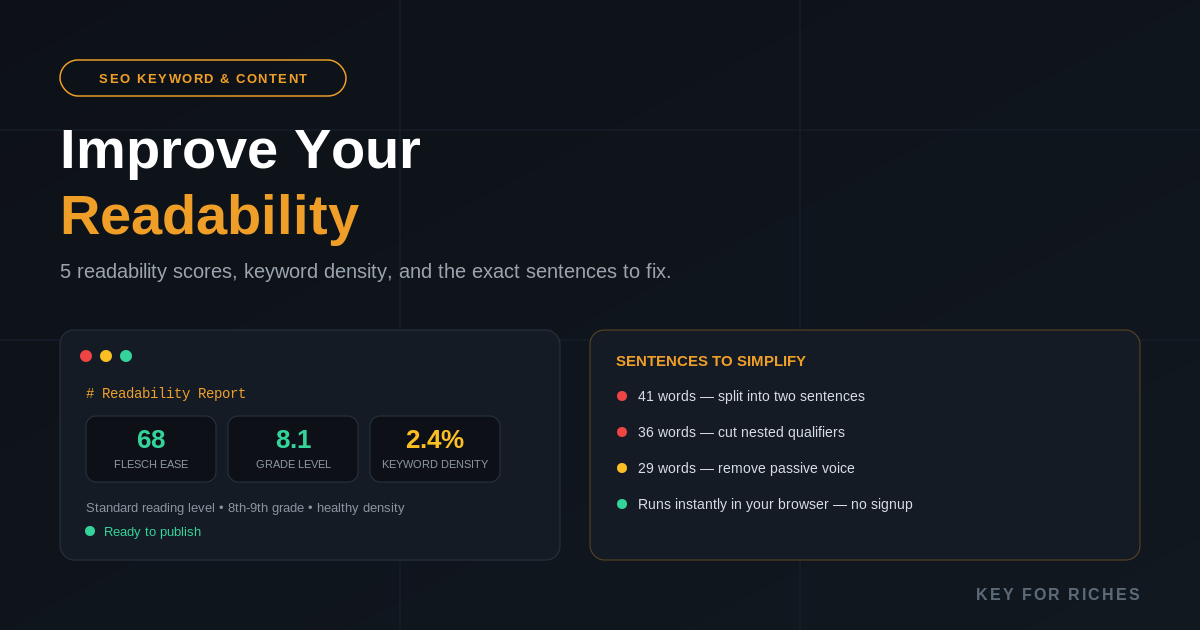
The Content Readability Checker is built specifically to sit in the SEO workflow rather than the general-writing workflow: it reports all five of the formulas SEO tools like Yoast have historically used (not just one), pairs them with a keyword density and prominence check in the same pass, lists every long sentence individually rather than only an average, and runs entirely client-side with nothing uploaded to a server. If you already use Hemingway or Grammarly for general prose clarity, this tool is a useful second pass specifically for the SEO-facing questions those tools don't answer — target keyword density, first-100-words prominence, and grade-level targets benchmarked against what actually correlates with search and engagement outcomes.
8. A Practical Editing Workflow
Write the first draft without stopping to optimize anything — readability edits belong in a second pass, not while you're still working out what you're trying to say. Once a draft exists, paste it into the free Content Readability Checker and start with the sentences-to-simplify list rather than the overall score; splitting the two or three longest sentences usually moves every formula more than a dozen small word swaps. Re-run the check, then scan the passive-voice count and jargon habits above for the sentences that remain hard even after splitting. Finally, check keyword density if you have a target term, and do one full read-aloud pass — reading aloud catches awkward phrasing that automated formulas structurally can't, since they only count sentence length and syllables, not actual clarity of meaning.
9. Before & After: Two Real Rewrites
These are worked examples, not claims about any specific published article — useful for seeing exactly what the fixes above look like applied to a real sentence.
Before (44 words, Flesch-Kincaid grade ~19): "In the event that your organization is currently experiencing difficulties with respect to the optimization of its content for the purposes of search engine visibility, it may be advisable to consider undertaking a comprehensive evaluation of the readability characteristics of the material in question."
After (2 sentences, 21 words total, grade ~7): "If your content isn't ranking, check its readability first. A quick audit often reveals sentences that are simply too hard to follow."
Before (passive, vague): "It was determined by the team that the page's bounce rate was being negatively impacted by factors that were not fully understood at the time."
After (active, specific): "The team traced the high bounce rate to slow load times and a confusing headline."
Notice that both rewrites are shorter, not just simpler — cutting words and cutting complexity usually happen together, which is why aggressive readability edits often improve a piece's total word efficiency as a side effect.
Check your draft with the Content Readability Checker
Paste your content and get five readability scores, a keyword density check, and the exact sentences to simplify — calculated instantly in your browser. Free, no signup.
For a field-by-field walkthrough of what each score means and how to interpret the results, see the full Content Readability Checker guide.
10. Quick Answers
What's a good Flesch Reading Ease score for a blog post? Most SEO tools, including Yoast, treat 60-70 as the target "good" range — roughly newspaper-level, readable by a 13-15 year old on one pass.
Is readability an official Google ranking factor? Not directly. It's not on Google's list of named ranking signals, but it strongly influences the engagement metrics and extractability that do factor into how helpful content systems evaluate a page.
Should technical content be dumbed down to a low grade level? No. Genuinely technical or B2B content can reasonably sit at grade 9-12; the goal is removing unnecessary complexity, not removing necessary precision.
How much keyword density is too much? Above roughly 3% starts to read as stuffing to both readers and spam-detection systems. Most practitioners aim for 0.5-2.5%.
Do readability formulas ever get it wrong? Yes — all of them rely on automated syllable or letter counting, which can misjudge proper nouns, acronyms, and unusual words. Use the scores as a directional signal, not a certified precision measurement, and always do a final human read-through.