1. What GEO Actually Is (and Where the Term Comes From)
Generative Engine Optimization is the practice of structuring content so that generative AI systems are more likely to retrieve it, quote it, and cite it in a synthesized answer. Unlike most SEO buzzwords, this one traces to an actual peer-reviewed source: a 2023 paper from researchers at Princeton and IIT Delhi, "GEO: Generative Engine Optimization," that introduced both the term and a benchmark called GEO-bench for measuring it. The paper's headline finding, cited constantly across the GEO content that followed, is that applying GEO techniques could boost a source's visibility in generative engine responses by up to 40%. Search Engine Land's own explainer on the term is a useful plain-language companion to the paper if you want the concept without the academic framing — see its "What is generative engine optimization (GEO)" primer.
That number is real, but the paper attaches an important qualifier that most articles quoting it leave out: "the efficacy of these strategies varies across domains." A 40% lift in one topic area doesn't guarantee anything close to that in another, and the paper's own framing treats GEO as a black-box optimization problem across many query types rather than a fixed set of five tricks that always work. Treat the 40% figure the way you'd treat any single-study statistic — directionally useful, not a guarantee you can bank on for your specific page.
2. What Google Itself Says About "AEO" and "GEO"
Google published its own guidance on optimizing content for generative AI features on Search, and it's noticeably more skeptical of the GEO/AEO framing than most of the industry writing about it. The guidance states plainly that "the best practices for SEO continue to be relevant because our generative AI features on Google Search are rooted in our core Search ranking and quality systems" — in other words, Google does not treat Answer Engine Optimization or Generative Engine Optimization as a separate discipline requiring different tactics from ordinary SEO fundamentals.
The guidance goes further than a shrug, too. It specifically warns against "commodity content" in favor of "unique expert or experienced takes that go beyond common knowledge," and it explicitly calls out a few popular "AI SEO" tactics as ineffective for its own systems: llms.txt files, keyword-stuffed long-tail variants, and inauthentic link building among them. It also pushes back on the idea that publishers need to artificially "chunk" their content into fragments for algorithms — Google says its systems are already able to "understand the nuance of multiple topics on a page and show the relevant piece to users." Coverage of the guidance in Search Engine Journal summarized the message bluntly: Google's new AI search guide calls AEO and GEO "still SEO." Google also maintains a separate reference on how AI features and your website interact, worth a read if you want the mechanics behind AI Overviews specifically.
3. The Six Structural Signals That Actually Move the Needle
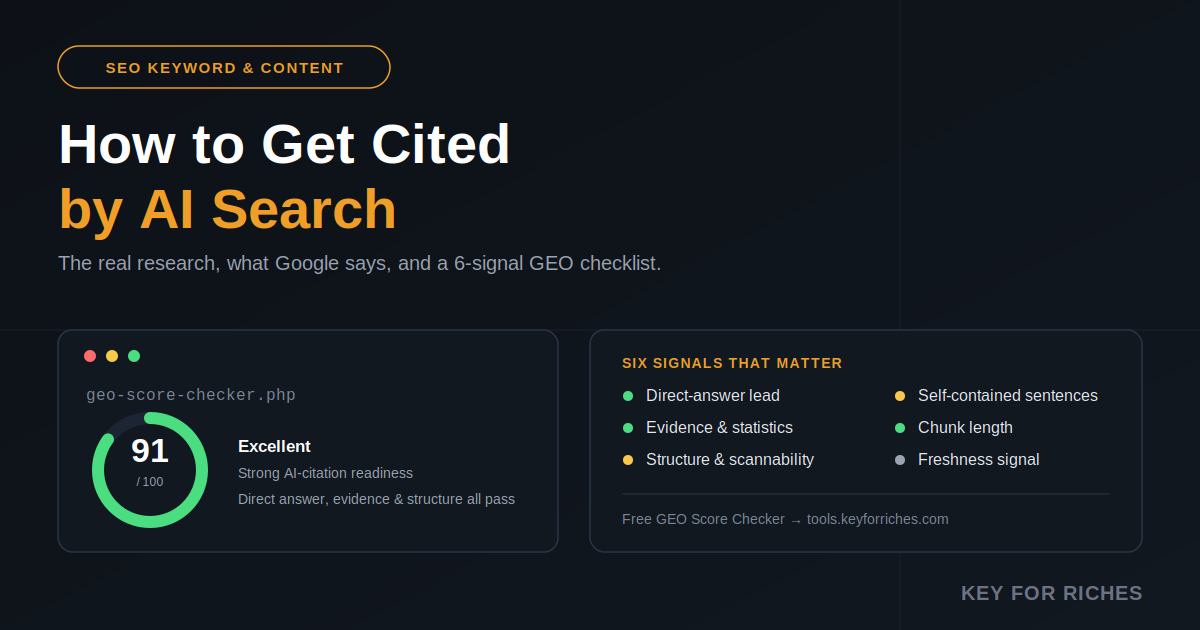
Setting aside anything that smells like a gimmick, a consistent, defensible set of structural signals shows up across the Princeton GEO research, Google's own guidance, and how retrieval-augmented generation (RAG) systems mechanically work under the hood. These are the six signals behind this site's free GEO Score Checker, and each one has a concrete reason to matter.
Direct-answer lead
Your first sentence should be able to stand alone as a quotable answer — a short, self-contained definition or statement, not a scene-setting preamble. "This matters because..." gives an extraction system nothing to lift; "A GEO score measures how easily AI systems can extract and cite your content" can be pulled verbatim into an answer. This is the single highest-weighted signal in the checker precisely because it's the sentence most likely to actually appear, quoted, in a generated response.
Evidence and statistics
Concrete numbers, dates, and attributed claims ("according to a 2026 study...") give a generative engine something specific and checkable to quote, and a named source gives it something to cite alongside your page. Generic, unsupported assertions are easy for a model to paraphrase into its own words without crediting anyone — specific, sourced claims are harder to detach from their origin.
Structure and scannability
Bulleted lists, numbered steps, and question-style subheadings map naturally onto how AI-generated answers are typically formatted. They also make it mechanically easier for a retrieval system to isolate one self-contained unit of your page instead of needing to summarize an undifferentiated block of prose. This is one area where Google's caution is worth heeding: structure your content for actual readability, not as a series of artificial fragments built purely to be machine-extractable.
Self-contained sentences
A sentence that opens with "This," "It," "They," or "These" depends on the sentence before it for meaning — quote it alone and it makes no sense. This is one of the more literature-backed GEO ideas, because it maps directly onto how RAG systems actually work: most split documents into chunks and embed each one independently, so a sentence that only makes sense next to its neighbor is mechanically less likely to survive retrieval intact.
Chunk length
Most retrieval pipelines split pages into chunks somewhere in the range of a few dozen to a couple hundred words. A paragraph that's a single sentence fragment or a 500-word wall of unbroken text is harder to retrieve as one clean, complete unit than a paragraph sized closer to that range. This isn't a rule to obsess over sentence-by-sentence — it's a reason to actually use paragraph breaks instead of one continuous stream of prose.
Freshness signal
The lightest-weighted of the six, but real: a visible current year or an "updated" date is a cheap, honest signal that content reflects the present. This matters far more for fast-moving topics — pricing, tool comparisons, statistics, "best of" roundups — than for genuinely evergreen explainers, which is exactly why it's weighted lowest in the checker rather than treated as equally important to the other five.
Score your own content with the GEO Score Checker
Paste any page or draft and get an instant 0-100 score across all six signals above — plus a flagged list of sentences that depend too heavily on context to quote in isolation. Calculated entirely in your browser, nothing sent anywhere. Free, no signup.
4. A Five-Minute GEO Checklist for One Page
Before you touch a full content audit, run this quick pass on a single high-value page:
- Read your opening sentence out of context. Does it answer a plausible question on its own, or does it need the sentence before or after it to make sense?
- Count how many concrete numbers, dates, or named sources appear in the first 300 words. Zero is a red flag; three to five is a reasonable target.
- Scan for at least one bulleted or numbered list, and at least one subheading phrased as a question a reader might actually type.
- Check your paragraph lengths. If most paragraphs run past 150 words with no break, split them — not for an algorithm's benefit, but because your readers are struggling with the same wall of text a retrieval system is.
- Confirm the page states a current year or an "updated" date somewhere visible, especially if the topic is time-sensitive.
- Run the page through the GEO Score Checker to see all six signals scored together, plus the specific sentences worth rewriting.
5. Common GEO Mistakes That Backfire
The most common failure mode is treating GEO as a checklist to satisfy instead of a proxy for genuine clarity. A few patterns worth avoiding specifically:
Bolting on an FAQ block that doesn't match the page. Stuffing five generic questions at the bottom of an article because "FAQs help with AI search" produces exactly the "commodity content" Google's guidance warns against. A real, useful FAQ answers questions people actually ask about your specific topic — that's the whole value, not the schema markup around it.
Chunking obsessively at the expense of readability. Breaking every paragraph down to two sentences to hit an ideal "chunk length" produces choppy, unpleasant prose. The goal is content that reads naturally in paragraphs of a sensible length — not content engineered sentence-by-sentence for a hypothetical embedding model.
Inflating statistics density with irrelevant numbers. Padding a paragraph with dates, percentages, or figures that don't actually support your point can trip a naive "evidence" heuristic (including this site's own checker) without adding real value. Every number should be doing genuine work in the sentence it's in.
Fabricating or misattributing sources. "According to research" with no actual research behind it is worse than no citation at all — if a model can't verify the claim, at best it gets ignored, and at worst it damages the credibility signals that trust and expertise actually depend on.
6. How GEO, Readability and E-E-A-T Fit Together
GEO, plain-language readability, and Google's E-E-A-T framework (Experience, Expertise, Authoritativeness, Trust) are three different lenses pointed at the same underlying target: content that's genuinely useful and easy to extract the truth from. A page can score well on GEO's structural signals while still failing on E-E-A-T if it lacks real expertise or a credible author — and a page with excellent expertise can still score poorly on GEO if its prose buries the actual answer three paragraphs deep in dense, jargon-heavy writing.
In practice, run all three checks rather than picking one: this site's Content Readability Checker for whether your prose itself is easy to read, the EEAT Content Improver for expertise and trust signals, and the GEO Score Checker for the specific structural patterns that affect AI extraction. None of the three substitutes for the others, and none of them substitutes for an actual human edit before you publish.
If you want to see whether any of this is currently paying off — whether your brand is actually showing up when people ask Claude or Google's AI Overviews about your space — the AI Visibility Checker is the closest free way to check that directly, rather than inferring it from structural signals alone.
7. Quick Answers
Is GEO a real, separate discipline from SEO? Google's own position, stated in its 2026 guidance for AI features on Search, is no — "the best practices for SEO continue to be relevant" and AEO/GEO tactics don't override them. Treat GEO as a specific lens on content structure within SEO, not a replacement for it.
Does the Princeton GEO paper's "40% visibility boost" apply to every page? No. The paper itself notes that "the efficacy of these strategies varies across domains" — the 40% figure is an aggregate finding across many query types in its benchmark, not a guaranteed lift for any individual page or topic.
Will adding an llms.txt file help my content get cited? Google's own guidance specifically lists llms.txt among the tactics it considers ineffective for its systems. It may still be worth having as a curated summary for AI systems that do choose to read it, but don't expect it to move your citation odds on its own — see our honest look at llms.txt adoption for more.
Should I restructure all my content around GEO signals immediately? Start with your highest-traffic or highest-intent pages rather than a site-wide rewrite. Structural signals are worth optimizing, but they're a multiplier on genuinely good content, not a substitute for it — a thin or inaccurate page with a perfect GEO score still won't be worth citing.
How is the GEO Score Checker's score different from an actual citation guarantee? There's no public API that reveals why ChatGPT, Perplexity, or Google chose to cite one page over another, so no free browser-based tool can measure real citation odds directly. The checker measures structural proxies correlated with extractability — a genuinely useful directional signal, not a certified prediction.